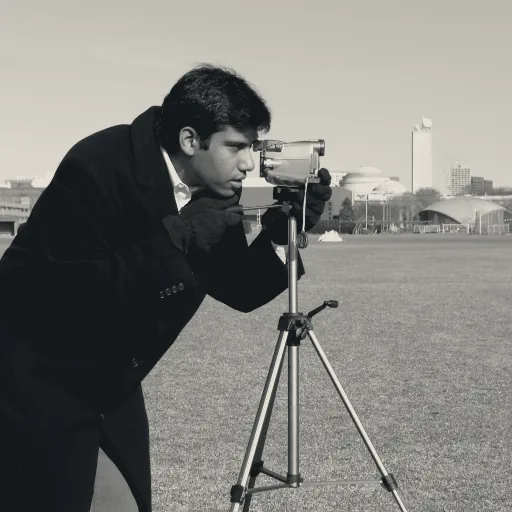
A practical guide to stronger photographs through framing, balance, rhythm, and intention.
Start with a decision
Before making a photograph, decide what the viewer should notice first. Your subject could be a face, a gesture, a pattern, or even a patch of light. Everything else in the frame either supports that decision or competes with it.
A useful exercise is to identify the subject in one sentence. If you cannot, try changing your position, moving closer, or simplifying the background. Composition begins with attention, not with a grid.
Use the edges of the frame
Look around all four edges before pressing the shutter. Are there bright distractions? Is a sign cut in half? Does a line meet a corner awkwardly? Small adjustments make a big difference, especially in photographs with strong geometry.
The rule of thirds is a useful starting point, but it is not a requirement. A centered portrait can be powerful; an off-center horizon can create tension. Choose deliberately rather than obeying a rule automatically.
Build depth and visual rhythm
Foreground, middle ground, and background can make a flat image feel like a place the viewer could enter. Look for repeating shapes, converging lines, and changes of scale.
Negative space is just as important. Empty sky, a blank wall, or a quiet shadow can isolate a subject and set the emotional tone.
Practice with one subject
Take ten photographs of the same object without moving it. Change only your camera position, distance, and framing. Compare how the meaning of the image changes. Then open the Composition Studio and test which guides help—and which do not.
Put one idea from this guide into practice and compare what changes. Explore the free Photo Lab for interactive experiments.
Keep looking
Photography improves through deliberate observation and repetition. Take the idea that interested you most, make several variations, and notice which choices actually change the image.
Continue with the learning library or make something using the Photo Lab.